Case Study
State Agency of Arts
Full design and development for the State Agency of Arts and Art Education.
Visit site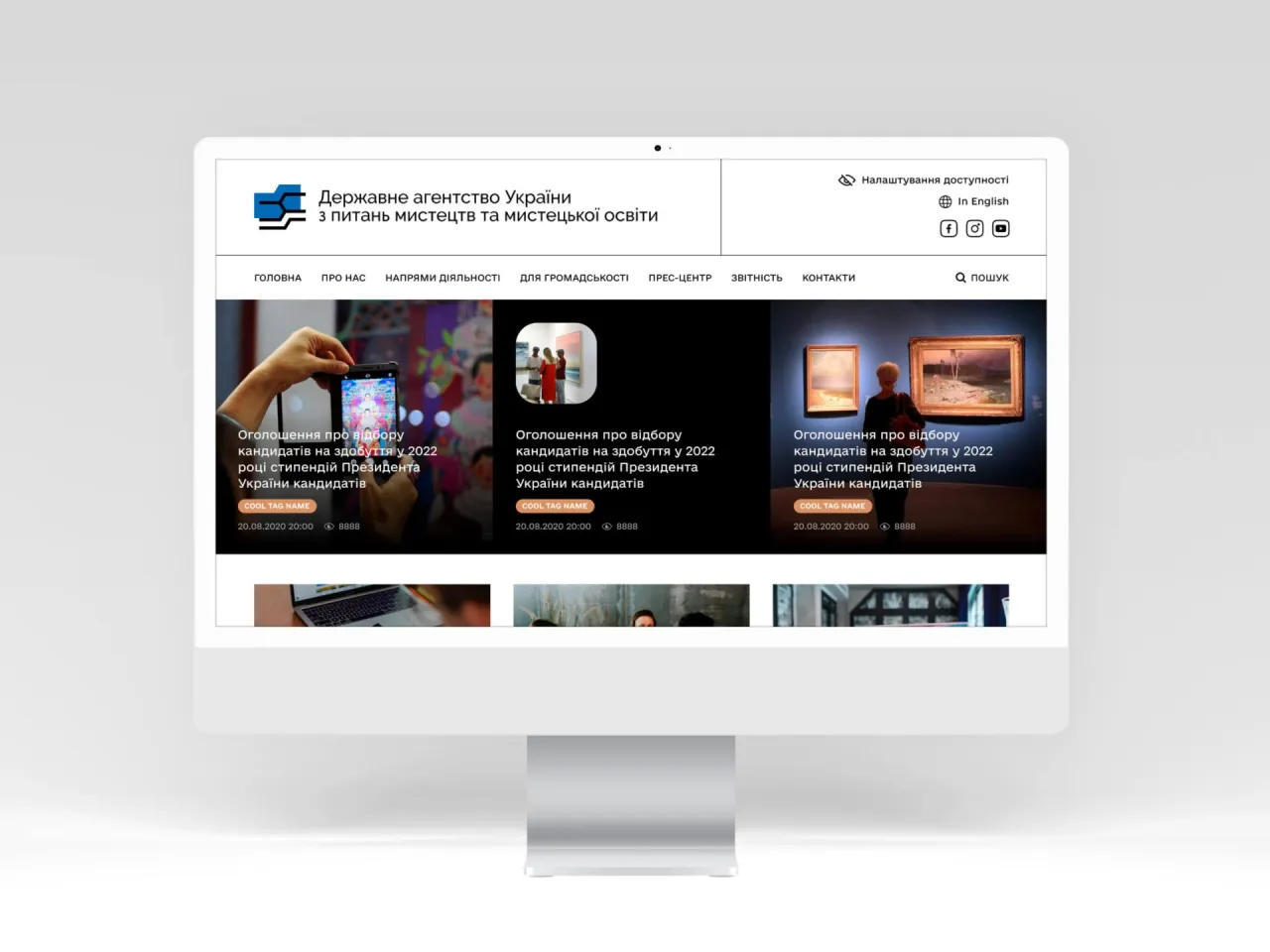
The project
Держмистецтв, the State Agency of Arts and Art Education, is the government body implementing state policy in the arts and in specialised arts education. Its website is the official channel between the agency and everyone it touches: cultural institutions, arts schools, professional artists, students, journalists and ordinary citizens filing an appeal.
A government portal is a different discipline from a commercial site. There is no single conversion to optimise. There is a legal obligation to publish certain things, an accessibility requirement that is not optional, an audience that includes people using screen readers and people on decade-old hardware, and a publishing cadence driven by whatever the agency announced that morning.
What we did
DForce delivered full design and development.
- About, Arts and Arts Education sections covering the agency's mandate, structure and the institutions under it.
- Public-service workflows as first-class paths: citizen appeals, public councils, access to public information, and corruption reporting. These are statutory obligations, and the usual failure mode is burying them three clicks deep. Here they sit in the main navigation.
- A press centre for news and announcements, carrying the day-to-day traffic and the agency's public voice.
- Built-in accessibility settings - text sizing and a plain "regular version" toggle available from the header on every page, alongside a dedicated barrier-free section.
- Reporting and transparency sections, which for a public body are part of the product rather than an appendix.
- Site search, a responsive mobile menu and social integration, plus support for flagship cultural initiatives such as "Тисячовесна".
Engineering notes
- Accessibility from the first screen, not from an audit. The accessibility controls are in the header of every page rather than on a settings screen, which is the difference between a compliance checkbox and something people actually use.
- The content model has to match how a ministry works. News, announcements, initiatives and statutory disclosures are different content types with different lifespans, so they are modelled separately rather than collapsed into one "news" bucket.
- Server-readable and content-heavy. Public-sector content has to be findable by search engines and by citizens who arrive with a very specific query, so the structure favours indexable, navigable pages over interactive cleverness.
- Longevity over fashion. A government site is maintained by whoever inherits it, so the build stays conventional on purpose.
Highlights
- A content-rich, server-readable government portal
- Accessibility and public-service workflows built in from the start
- Represents a state agency to professionals, students and the public
Services: Product, Design, Engineering. · arts.gov.ua